
Subdomain vs Custom Domain vs Marketplace Store: Which Builds a Real Brand?
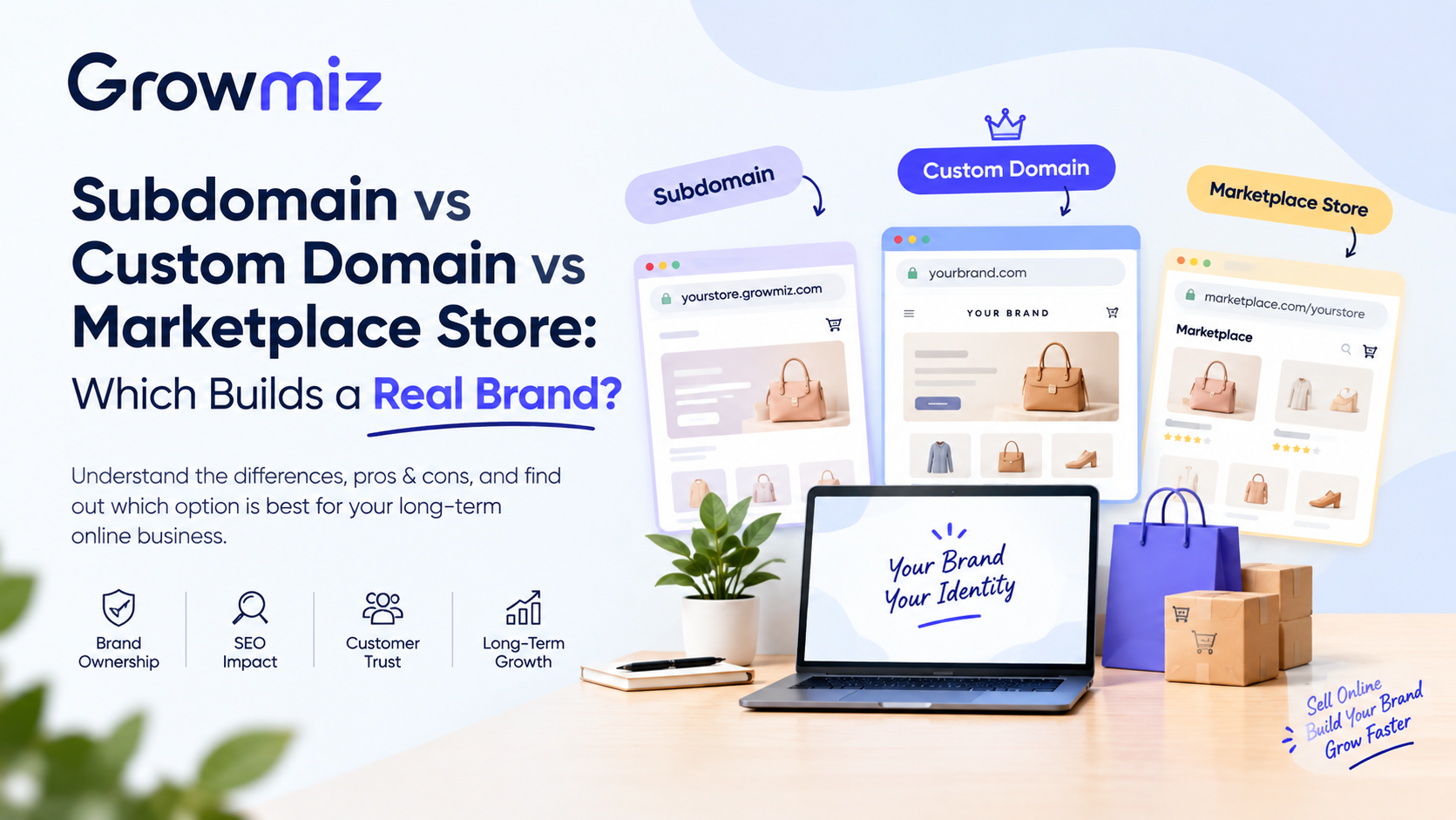
A small business can create a store, upload products, accept payments and start selling online without investing heavily in technology. But before launching, there is one decision that often gets overlooked: Where should your online store actually live?
Introduction
Starting an online business today is easier than ever.
A small business can create a store, upload products, accept payments and start selling online without investing heavily in technology. But before launching, there is one decision that often gets overlooked:
Where should your online store actually live?
You may have three common choices:
A subdomain provided by an ecommerce platform Your own custom domain A store on a large marketplace
For example, a business could sell through:
yourstore.growmiz.com — a subdomain
or
yourstore.com — a custom domain
or
MarketplaceName.com/yourstore — a marketplace store
All three can help you sell online, but they don't build your brand in the same way.
If your goal is simply to start selling quickly, a marketplace or subdomain can be enough. But if your goal is to build a business that customers remember, search for and return to directly, your domain and your brand ownership become increasingly important.
So, which option should a small business choose?
Let's break it down.
What Is a Subdomain?
A subdomain is a section of a larger domain.
For example:
yourstore.growmiz.com
Here:
growmiz.com is the main domain yourstore is the subdomain
Many ecommerce platforms provide businesses with a free or included subdomain when they create an online store.
Why businesses use subdomains
A subdomain is convenient because you don't necessarily need to purchase and configure a separate domain immediately.
It can be useful when:
You are testing your business idea You are just starting online Your budget is limited You want to launch quickly You haven't decided on your permanent brand name You want to test products before investing further
For a new seller, this can be a practical starting point.
Advantages of a Subdomain
- Easy to Set Up
You can often create a store without dealing with domain registration, DNS settings or technical configuration.
- Lower Initial Cost
Depending on the ecommerce platform, the subdomain may be included with your store plan.
- Good for Testing
If you are experimenting with a new business idea, a subdomain allows you to get online quickly.
- Platform Integration
Your store remains closely connected to the ecommerce platform that powers it.
- Suitable for Early-Stage Businesses
For someone who is still validating their products and market, it can be a sensible temporary solution.
Disadvantages of a Subdomain
The biggest limitation is brand ownership and perception.
Consider these two URLs:
fashionstore.growmiz.com
and
fashionstore.in
Which one feels more like an independent brand?
For many customers, the second one immediately looks like the business has its own online identity.
A subdomain can also make your business appear more dependent on the platform hosting your store.
This doesn't mean customers won't trust it. It simply means your brand identity is sharing attention with another company's domain.
Other limitations may include: Less memorable URL Platform dependency Weaker standalone brand perception Harder to establish a completely independent digital identity Customers may associate the store more strongly with the platform than with the business
A subdomain is therefore often better viewed as a starting point, rather than the final destination for a serious brand.
What Is a Custom Domain?
A custom domain is a web address that belongs specifically to your business.
Examples:
yourbrand.com yourbrand.in yourbrandstore.com
Instead of customers remembering the platform that powers your store, they remember your business name.
For example:
Visit yourbrand.in
is much more direct than:
Visit yourbrand.platformname.com
A custom domain separates your brand identity from the technology powering your store.
That's one of its biggest advantages.
Why a Custom Domain Matters for Branding
Imagine a customer discovers your business through Instagram.
They like your products and want to visit your website.
If your website is:
myfashionstore.growmiz.com
they may remember the store name but forget the platform name or URL structure.
With:
myfashionstore.in
the website address and the brand become closely connected.
Over time, customers may:
Search your brand directly Type your domain into their browser Bookmark your website Share your website Recommend your website to friends Recognize your URL on packaging and advertisements
The domain becomes a part of your brand identity.
Advantages of a Custom Domain
- Stronger Brand Identity
Your domain becomes an extension of your business name.
- Greater Customer Trust
A professional domain can make a small business appear more established.
- Easier to Remember
A short, relevant domain is easier to communicate.
- Better Marketing
You can print your domain on:
Visiting cards Packaging Brochures Banners Product labels Social media posts Advertisements WhatsApp messages 5. More Independence
Your website address isn't tied to another company's primary domain.
- Long-Term Asset
A good domain can remain part of your brand as your business grows.
Does a Custom Domain Automatically Improve SEO?
This is an important distinction.
Simply buying a custom domain does not automatically guarantee higher Google rankings.
Search engines consider many factors, including:
Content quality Relevance Website structure Technical SEO Page experience Backlinks Search intent Mobile usability Website authority
A custom domain can, however, provide a stronger foundation for building a standalone website and brand over time.
The important point is:
Domain ownership is part of building your digital identity, not a shortcut to SEO rankings.
What Is a Marketplace Store?
A marketplace is a platform where many businesses sell products under one larger website.
Examples include large ecommerce marketplaces where customers can browse products from thousands of sellers.
Your store might appear as:
Marketplace.com/YourStore
or customers may simply discover your product through marketplace search results.
This is fundamentally different from having your own website.
On your own website, the customer is primarily interacting with your brand.
On a marketplace, the customer is primarily interacting with the marketplace ecosystem.
Why Businesses Sell on Marketplaces
Marketplaces have one major advantage:
They already have customers.
A new business doesn't necessarily need to convince customers to visit an unknown website.
Customers are already searching for products on the marketplace.
This can make marketplaces extremely useful for product discovery.
For a new seller, this may mean:
Create account → Upload products → Receive orders
instead of:
Create website → Build traffic → Run marketing → Generate awareness → Get orders
That's a major difference.
Advantages of Marketplace Stores Existing Customer Traffic
You can potentially access customers who are already shopping.
Faster Product Discovery
Customers may find your products through marketplace searches and recommendations.
Established Trust
Large marketplaces often have existing customer recognition.
Built-In Infrastructure
Depending on the marketplace, you may get access to:
Payments Shipping Order management Customer reviews Returns infrastructure Advertising tools Analytics Useful for Product Testing
Marketplaces can help businesses understand which products customers actually want.
Disadvantages of Marketplace Stores
The biggest problem is limited brand ownership of the customer relationship.
Your product may be displayed alongside dozens of competitors selling similar products.
A customer might remember:
"I bought this from a marketplace."
rather than:
"I bought this from XYZ Brand."
Other challenges include: Strong competition Marketplace fees Price comparison Dependence on marketplace policies Limited control over customer experience Limited control over website design Competition within search results Difficulty differentiating your brand Platform dependency
A marketplace can be an excellent sales channel, but it shouldn't necessarily be your only digital home if your long-term goal is to build a recognizable brand.
Subdomain vs Custom Domain vs Marketplace
Here's a simple comparison:
Factor Subdomain Custom Domain Marketplace Store Setup Very easy Easy Very easy Initial cost Low Low–moderate Usually low to start Brand ownership Moderate High Low–moderate Brand recognition Moderate Excellent Limited Customer relationship Good Strong More platform-controlled Design control Good High Limited Existing traffic Limited You build it High potential Competition Moderate Your own site Very high Pricing pressure Moderate Lower High Long-term brand building Good Best Limited Independence Moderate High Low Best for Starting/testing Building a brand Reaching existing shoppers Which Option Builds the Strongest Brand?
If the question is specifically:
"Which option builds a real brand?"
The answer is:
Custom Domain — Strongest for Long-Term Brand Building
A custom domain gives your business its own digital identity.
However, that doesn't mean you should completely avoid subdomains or marketplaces.
In fact, the strongest strategy for many small businesses is to use all three strategically.
The Best Strategy: Don't Choose Only One
A modern small business doesn't necessarily have to choose between its website and marketplaces.
Instead, think of them as different channels.
Your Custom Domain
Your brand headquarters.
Use it for:
Your main website Product catalog Customer accounts Brand story Blog Offers Direct sales Customer retention Marketplace
Your customer acquisition channel.
Use it for:
Product discovery Reaching new customers Testing products Generating additional sales Subdomain
Your starting point or supporting channel.
Use it when:
You're testing your business You haven't purchased a domain yet You need a quick store launch You want to experiment before investing more
This creates a much healthier online ecosystem.
Example: How a Small Clothing Brand Can Use All Three
Imagine a clothing business called Urban Threads.
Stage 1: Starting
The business launches:
urbanthreads.growmiz.com
The owner tests products and starts receiving orders.
Stage 2: Building the Brand
After validating the business, they purchase:
urbanthreads.in
Now their website, packaging and advertising use the custom domain.
Stage 3: Expanding Reach
They also list selected products on marketplaces.
Now they have:
Custom Website → Brand & Customer Relationship
Marketplace → New Customer Acquisition
Social Media → Awareness & Traffic
This is much stronger than depending entirely on one platform.
What About Social Media?
Social media should also be treated as a marketing channel, not necessarily your entire online business.
Instagram, Facebook, YouTube, WhatsApp and other platforms are excellent for:
Awareness Product discovery Engagement Customer communication Promotions Community building
But social media platforms can change:
Algorithms Reach Advertising costs Features Policies
Your website and domain provide a more stable digital destination.
A useful way to think about it is:
Social Media → Brings Attention
Marketplace → Brings Potential Buyers
Your Website → Builds Your Brand
Why Small Businesses Should Think Beyond "Getting Orders"
When starting ecommerce, it's easy to focus on:
How many orders did I get this month?
But long-term businesses need to think about:
How many customers remember my brand? How many customers return? How many customers purchase directly? How many customers recommend me? How much customer data can I legitimately retain and use? How dependent am I on one platform? Can customers find me without a marketplace?
These questions determine whether you are simply selling online or actually building an online business.
Custom Domain + Customer Retention
Your custom domain becomes even more valuable when combined with customer retention tools.
For example, your store can encourage customers to:
Create accounts Join loyalty programs Earn reward points Receive gift cards Subscribe to updates Reorder products Refer friends Save their preferences
This allows your website to become more than a product catalog.
It becomes a place where customers develop an ongoing relationship with your business.
When Should a Business Buy a Custom Domain?
Ideally, as early as practical.
You don't necessarily need to wait until your business becomes large.
If you already know your brand name and intend to operate for the long term, securing an appropriate domain early can make sense.
A good domain should ideally be:
Short Easy to spell Easy to pronounce Relevant to your brand Easy to remember Avoid unnecessary numbers Avoid confusing spelling Suitable for future growth
For Indian businesses, .in can be a natural choice, while .com is also widely recognized globally.
The best choice depends on availability, branding and your target market.
Should You Start With a Subdomain and Upgrade Later?
Yes, this can be a practical approach.
If you're not ready to purchase a domain or are still testing your business idea, start with a subdomain.
Once you have validated your concept:
Buy your domain → Connect it to your store → Update your marketing materials → Build your brand around the custom domain.
The important thing is to avoid delaying the transition indefinitely if you're serious about building a long-term brand.
Should You Sell Only Through a Marketplace?
For most businesses with long-term ambitions, relying entirely on one marketplace can be risky.
Marketplaces are valuable, but they are someone else's platform.
Changes to:
Fees Search algorithms Seller policies Advertising systems Competition Account rules
can affect your business.
Having your own website gives you another channel and reduces your dependence on a single platform.
This is especially important as your business grows.
The Omnichannel Approach
A stronger ecommerce strategy is to build an omnichannel presence.
For example:
Instagram ↓ Customer discovers your brand
WhatsApp ↓ Customer asks questions
Marketplace ↓ Customer discovers or purchases a product
Your Website ↓ Customer explores your brand and purchases directly
Loyalty Program ↓ Customer returns
Referral ↓ Customer brings another buyer
Each channel has a different purpose.
The custom domain acts as the central point that ties the brand together.
How Growmiz Fits Into This Strategy
For small businesses, building an online store shouldn't require starting with a complicated technology setup.
The important thing is to have a platform that allows you to establish your store, present your products professionally and grow your digital presence over time.
With Growmiz, a business can use its online store as a foundation for building a recognizable digital brand rather than treating ecommerce only as a place to list products.
A practical growth path can look like:
Start your store → Connect your custom domain → Promote your website → Build customer relationships → Add retention tools → Expand to additional sales channels.
This approach allows small businesses to start simple while keeping their long-term brand in mind.
Final Verdict: Which One Should You Choose?
There isn't one option that is perfect for every business.
Choose a Subdomain If: You're just starting You want to test your idea Your budget is limited You need a quick launch Choose a Custom Domain If: You want to build a serious brand You want customers to remember your business You want greater control over your online identity You're planning for long-term growth Choose a Marketplace If: You want access to existing shoppers You're testing product demand You want another sales channel You want to increase product visibility Choose All Three Strategically If:
You want both immediate sales and long-term brand growth.
That's often the smartest approach.
Conclusion
A marketplace can help you sell products.
A subdomain can help you start an online store.
But a custom domain can help you build a digital identity around your own brand.
The real objective isn't simply to have a website.
It's to create an online presence where customers recognize your name, trust your business, return to purchase again and recommend you to others.
For a small business planning to grow, the ideal journey can be:
Start simple → Validate your business → Get your custom domain → Build your own website → Use marketplaces for reach → Bring customers back to your brand.
Because in the long run, the most valuable thing isn't just the number of orders you receive.
It's the number of customers who remember your brand and choose you again.
Frequently Asked Questions Is a custom domain better than a subdomain?
For long-term brand building, generally yes. A custom domain gives your business an independent web address and stronger brand identity.
Is selling on a marketplace bad for branding?
No. Marketplaces can be excellent for reaching new customers. The challenge comes when a business relies entirely on a marketplace and doesn't develop its own brand presence.
Does a custom domain increase customer trust?
A professional, relevant domain can contribute to a more credible and established online presence, although trust also depends heavily on product quality, reviews, customer service, website experience and business transparency.
Can I use a custom domain with an ecommerce platform?
Yes. Many ecommerce platforms allow businesses to connect a domain they own to their online store.
Should a new business start with a marketplace or its own website?
If possible, consider both. A marketplace can help with customer discovery, while your own website gives you greater control over your brand and customer experience.
Is .com better than .in for an Indian business?
Not necessarily. .com is globally familiar, while .in clearly signals an Indian presence. Choose based on your target audience, brand availability and long-term plans.
Can I move from a subdomain to a custom domain later?
Yes, in many ecommerce setups you can connect a custom domain later. However, it's better to plan your branding and domain strategy early rather than changing everything after your business becomes established.
What is the biggest difference between a marketplace and your own website?
On a marketplace, customers are shopping within a platform that hosts many sellers. On your own website, the customer experience is centered around your brand.
Quick Takeaway
Subdomain = Start quickly Marketplace = Reach existing shoppers Custom Domain = Build your brand All three together = Build, reach and grow
Growmiz — Build your online store. Build your brand. Grow your business