
Loyalty Points & Gift Cards: How Small Stores Can Build Repeat Customers Online
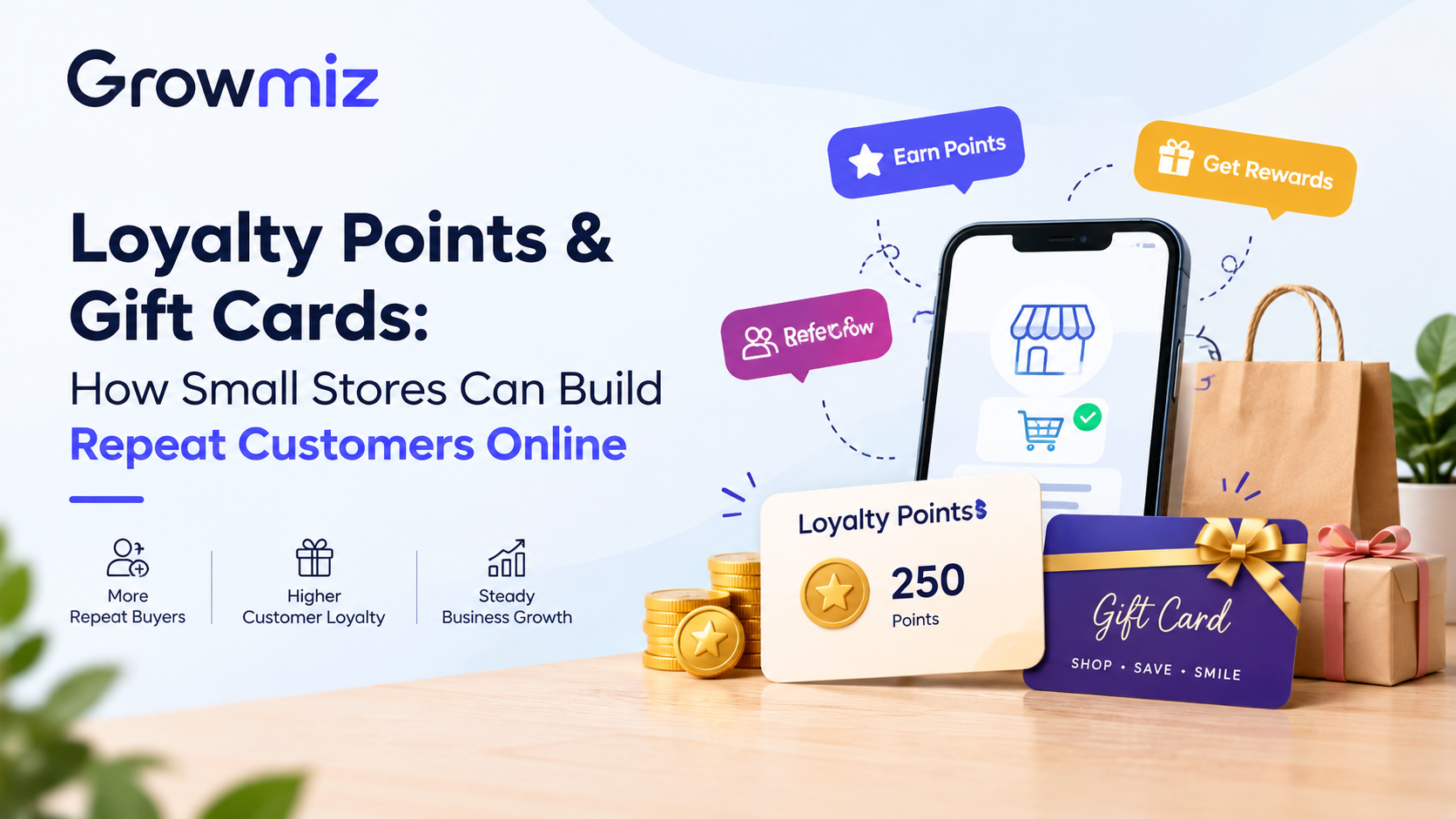
Getting a customer to make their first purchase is only the beginning. For small stores selling online, the bigger challenge is getting that customer to come back again — and again. Large ecommerce companies spend heavily on advertising, discounts, memberships, and personalized recommendations to encourage repeat pur
Loyalty Points & Gift Cards: How Small Stores Can Build Repeat Customers Online
Introduction
Getting a customer to make their first purchase is only the beginning.
For small stores selling online, the bigger challenge is getting that customer to come back again — and again.
Large ecommerce companies spend heavily on advertising, discounts, memberships, and personalized recommendations to encourage repeat purchases. But small businesses don't necessarily need a complicated loyalty system or a huge marketing budget to achieve the same goal.
Simple tools such as loyalty points, digital gift cards, referral rewards, special offers, and personalized incentives can give customers a reason to return.
A well-designed loyalty program turns a normal transaction into an ongoing relationship. Instead of asking, "How can I get more customers?" small businesses can also ask:
"How can I make the customers I already have want to buy from me again?"
This is particularly important for Indian small businesses, where repeat customers, personal relationships, WhatsApp communication, and word-of-mouth recommendations can play a major role in growth. Recent retail and ecommerce discussions increasingly focus on retention because acquiring a new customer can require considerably more marketing effort than encouraging an existing customer to purchase again.
What Is a Customer Loyalty Program?
A customer loyalty program is a system that rewards customers for purchasing from or engaging with a business repeatedly.
The reward could be:
- Loyalty points
- Cashback
- Discounts
- Free products
- Digital coupons
- Gift cards
- Free delivery
- Early access to products
- Birthday or anniversary offers
- Referral rewards
- Exclusive member benefits
The concept is simple:
The more valuable the customer relationship becomes, the more benefits the customer receives.
For example, an online clothing store could offer:
Earn 1 point for every ₹10 spent. Collect 500 points and get ₹100 off your next order.
The customer now has a reason to return to the same store instead of purchasing from a competitor.
Why Repeat Customers Matter for Small Stores
Small businesses often focus heavily on acquiring new customers through Instagram, Google, WhatsApp, local advertising, influencers, and other marketing channels.
Acquisition is important, but it should not be the entire growth strategy.
An existing customer has already:
- Discovered your business
- Trusted your brand
- Completed a purchase
- Experienced your product
- Gone through your checkout process
- Shared some information with your business
That makes the second purchase much easier to encourage than starting from zero with a completely new customer.
A loyalty program gives customers an additional reason to return.
Instead of:
Purchase → Thank you → Relationship ends
you create:
Purchase → Earn reward → Return → Earn more → Redeem → Purchase again
This creates a repeat-purchase cycle.
Loyalty Points: A Simple Way to Encourage Repeat Purchases
Loyalty points are one of the easiest loyalty mechanisms for an online store.
Customers earn points based on their purchases or other valuable actions.
For example:
| Customer Action | Reward |
|---|---|
| Spend ₹100 | 10 points |
| Create an account | 50 points |
| Place first order | 100 points |
| Refer a friend | 200 points |
| Leave a review | 50 points |
| Birthday purchase | 150 bonus points |
The business can then define how those points can be redeemed.
For example:
100 points = ₹10 discount
This makes the reward easy to understand.
Why points work
Points create a sense of progress.
A customer who sees:
"You have 420 points. Only 80 points away from ₹50 off!"
has a clear reason to consider another purchase.
The important part is making the value easy to understand. Customers should not have to perform complicated calculations to know what their points are worth.
How Many Loyalty Points Should a Small Store Offer?
There is no universal number that works for every business.
The reward should be attractive enough to motivate customers without reducing your profit margins.
For example, a store could choose:
₹100 spent = 1 point 100 points = ₹10 discount
Or:
₹100 spent = 5 points 500 points = ₹100 discount
The exact structure should depend on:
- Product margins
- Average order value
- Purchase frequency
- Customer lifetime value
- Competition
- Desired repeat-purchase rate
The goal isn't to give away the biggest discount.
The goal is to create a small but meaningful reason to return.
Don't Make Customers Wait Too Long for Rewards
One common mistake businesses make is setting the reward threshold too high.
Imagine a customer has to spend ₹20,000 before receiving any meaningful benefit.
For a small retailer, that may feel unrealistic to the customer.
Instead, consider smaller milestones.
For example:
- ₹250 spent → ₹10 reward
- ₹500 spent → ₹25 reward
- ₹1,000 spent → ₹60 reward
Small rewards can make the loyalty program feel achievable.
A good loyalty program should make customers think:
"I'm already close to my next reward."
rather than:
"I'll never reach that reward."
What Are Digital Gift Cards?
A digital gift card is a prepaid value that can be used to purchase products or services from a business.
For example:
₹500 Growmiz Store Gift Card
The customer can receive the gift card digitally and use it during checkout.
Gift cards can be useful for both customer acquisition and retention.
They can be sold directly to customers or given as rewards.
For example:
Spend ₹2,500 this month and receive a ₹250 gift card for your next purchase.
The customer now has a financial reason to return.
Why Gift Cards Can Encourage Repeat Purchases
Gift cards create something different from ordinary discounts.
A discount reduces the price of the current purchase.
A gift card can encourage a future purchase.
For example:
Regular discount
"Get ₹100 off today."
The benefit is used immediately.
Gift-card incentive
"Spend ₹1,000 today and get a ₹100 gift card for your next order."
The customer receives an incentive that is tied to returning.
Gift cards can therefore become part of a broader retention strategy when the terms are clear and the reward is genuinely useful.
Loyalty Points vs Gift Cards: What's Better?
Both can work, but they serve slightly different purposes.
| Feature | Loyalty Points | Gift Cards |
|---|---|---|
| Encourages repeat purchases | Excellent | Excellent |
| Easy to understand | Moderate | Very easy |
| Suitable for frequent purchases | Excellent | Good |
| Useful for gifting | Limited | Excellent |
| Referral campaigns | Good | Excellent |
| Customer progress tracking | Excellent | Limited |
| Promotional campaigns | Excellent | Excellent |
| Customer acquisition | Moderate | Strong |
| Builds long-term loyalty | Strong | Moderate to strong |
For many small stores, the best strategy isn't choosing one.
Use both.
For example:
- Points for regular purchases
- Gift cards for major milestones
- Referral rewards for bringing new customers
- Birthday coupons for personal engagement
How Small Stores Can Combine Loyalty Points and Gift Cards
A strong loyalty system can have multiple levels.
Level 1: Welcome Reward
Give new customers:
100 bonus points on their first order.
This encourages them to create an account and start participating.
Level 2: Purchase Rewards
Give points for every purchase.
₹100 spent = 5 points
Level 3: Milestone Reward
When customers reach a specific spending level:
Spend ₹5,000 → Receive ₹250 gift card
Level 4: Referral Reward
Customer refers a friend.
Friend gets ₹100 off + existing customer gets 200 points.
Level 5: Special Occasions
Offer bonus points or gift cards during:
- Birthdays
- Anniversaries
- Festivals
- Store anniversaries
- Product launches
- Special sales
This makes the program feel more personal rather than simply transactional.
Make Your Loyalty Program Useful for Your Type of Business
Not every business should use the same loyalty strategy.
Grocery Stores
Customers purchase frequently, so simple points or cashback can work well.
Example:
Earn ₹5 reward for every ₹500 spent.
You could also offer additional rewards for monthly purchases.
Clothing Stores
Purchases may happen less frequently but have a higher order value.
Consider:
- Tiered memberships
- Festival rewards
- Birthday coupons
- Early access
- Gift cards
Example:
Spend ₹5,000 in a year and become a Gold Member.
Beauty & Salon Businesses
Frequency is more important.
Consider:
Book 5 services → Get ₹500 off your next service.
You can also offer birthday rewards and referral bonuses.
Restaurants & Cafés
Simple rewards work best.
For example:
Earn 1 point for every ₹10 spent.
Or:
Buy 9 coffees, get the 10th free.
Digital reward cards can make this process easier.
Electronics & Higher-Value Stores
Customers may not purchase frequently, so loyalty should focus on:
- Referrals
- Accessories
- Extended benefits
- Gift cards
- Service discounts
- Future purchase rewards
Use Gift Cards for Customer Referrals
Gift cards can become a powerful referral tool.
Instead of simply saying:
"Refer a friend."
give customers a clear benefit.
For example:
Give your friend ₹200 off their first order and receive a ₹200 gift card when they purchase.
This creates a win-win situation.
Your existing customer gets a reward.
The new customer gets an incentive.
Your business gets a new potential long-term customer.
Create Loyalty Tiers
Once your customer base grows, you can introduce different membership levels.
For example:
Silver
Spend ₹2,000 annually
- 2% loyalty reward
- Birthday coupon
- Member-only offers
Gold
Spend ₹5,000 annually
- 4% loyalty reward
- Free delivery on selected orders
- Birthday gift
- Early access to sales
Platinum
Spend ₹10,000 annually
- 6% loyalty reward
- Priority support
- Exclusive offers
- Special gift cards
- Early access to new products
Tiered loyalty programs can make customers feel recognized and give them a reason to reach the next level.
Don't Turn Loyalty Into a Discount War
This is one of the most important points.
A loyalty program should not mean:
"Give customers discounts every time they buy."
If customers only purchase when a discount is available, you may increase sales while damaging your margins.
Instead, rewards can include benefits that don't always reduce the product price.
For example:
- Free shipping
- Early access
- Priority support
- Exclusive products
- Birthday rewards
- Bonus points
- Free samples
- Gift wrapping
- Members-only events
This allows you to create value without constantly lowering prices.
Use WhatsApp to Remind Customers About Their Rewards
For Indian small businesses, WhatsApp can be an important customer communication channel.
Instead of expecting customers to remember their points, send useful reminders such as:
"You have ₹120 in rewards waiting for you. Use them on your next order."
Or:
"You're only 80 points away from your ₹100 reward!"
Or:
"Your ₹250 gift card expires on September 30. Use it on your next purchase."
The message should be useful, concise, and sent with appropriate customer consent.
The objective isn't to spam customers.
It is to remind them about a benefit they have already earned.
Personalization Makes Loyalty Programs More Effective
A generic message sent to everyone may not be very effective.
Instead, use customer purchase history where appropriate.
For example:
Customer A: Frequently buys skincare products.
Send:
"Your usual skincare products are back in stock. You also have ₹75 in loyalty rewards available."
Customer B: Purchased a birthday gift last year.
Send:
"Planning a birthday gift again this year? Here's a special ₹200 gift card for your next order."
Personalized communication makes customers feel recognized.
Reward More Than Just Purchases
Loyalty doesn't have to be based only on spending.
You can reward customers for actions that help your business grow.
For example:
| Customer Action | Possible Reward |
|---|---|
| Create an account | 50 points |
| First purchase | 100 points |
| Second purchase | 150 points |
| Leave a review | 50 points |
| Refer a friend | 200 points |
| Share a product | 25 points |
| Birthday | 100 bonus points |
| Festival purchase | 2X points |
This turns your loyalty program into a broader customer engagement system.
Create Festival-Based Loyalty Campaigns
India has a strong festival and gifting culture, making seasonal loyalty campaigns particularly useful.
You can run campaigns around:
- Diwali
- Eid
- Raksha Bandhan
- Holi
- Navratri
- Christmas
- New Year
- Wedding season
For example:
Diwali Double Rewards
Earn 2X loyalty points on every purchase above ₹1,000.
Festival Gift Card
Spend ₹2,500 and receive a ₹250 gift card.
Referral Festival Offer
Refer a friend and both customers receive ₹150 in rewards.
The important thing is to keep the offer easy to understand.
Add an Expiry Date Carefully
Expiry dates can create urgency, but they should be communicated clearly.
For example:
You have ₹100 in rewards. Use them before September 30.
This encourages customers to return.
However, businesses should avoid confusing or unfair expiry policies.
Always clearly communicate:
- Reward value
- Expiry date
- Minimum purchase requirements
- Eligible products
- Redemption rules
- Whether rewards can be combined
- Refund/cancellation treatment
Transparency builds trust.
Make Redemption Extremely Simple
One of the biggest mistakes a business can make is creating a loyalty program that is difficult to use.
Customers shouldn't need to:
- Call customer support
- Send screenshots
- Remember complicated codes
- Visit a physical store unnecessarily
- Calculate points manually
The ideal experience is:
Login → See rewards → Apply reward → Checkout
The easier redemption becomes, the more likely customers are to use the program.
Track the Right Loyalty Metrics
Launching a loyalty program isn't enough.
You need to know whether it is actually improving your business.
Track metrics such as:
1. Repeat Purchase Rate
How many customers make another purchase after their first order?
2. Purchase Frequency
How often do customers return?
3. Average Order Value
Are loyal customers spending more per transaction?
4. Redemption Rate
How many earned rewards are actually being used?
5. Customer Lifetime Value
How much revenue does an average customer generate over the entire relationship?
6. Referral Rate
How many new customers are being generated by existing customers?
7. Active Loyalty Members
How many customers actively participate in the program?
8. Reward Cost
How much are rewards costing your business compared with the additional revenue generated?
These metrics help you determine whether your loyalty program is creating real business value.
A Simple Loyalty Strategy for a Small Online Store
If you're just starting, don't build a complicated system.
Start with something like this:
Step 1: Welcome Reward
Give every new customer:
100 points
Step 2: Purchase Reward
Give:
5 points for every ₹100 spent
Step 3: Review Reward
Give:
50 points for a verified product review
Step 4: Referral Reward
Give:
200 points for every successful referral
Step 5: Milestone Reward
After earning 500 points:
₹50 reward
Step 6: Special Campaign
Run:
2X points during selected festivals
Step 7: Reminder
Send customers a reminder when they are close to a reward or have unused rewards.
This is enough to start building a structured retention system without overwhelming customers or the business.
Common Loyalty Program Mistakes to Avoid
1. Making the Program Complicated
Customers should understand the reward within seconds.
2. Giving Rewards That Have Little Value
A reward should feel worth earning.
3. Setting Extremely High Redemption Limits
Customers need to believe they can realistically earn rewards.
4. Giving Discounts on Every Purchase
This can reduce margins and train customers to wait for offers.
5. Forgetting Existing Customers
Don't focus only on acquiring new customers. Your existing customer base is one of your most valuable assets.
6. Not Promoting the Program
Customers cannot use a loyalty program they don't know exists.
Mention it:
- On your website
- At checkout
- On WhatsApp
- In order confirmation messages
- On packaging
- On social media
- In email campaigns
7. Not Measuring Results
Always compare customer behaviour before and after launching the program.
How Growmiz Can Help Small Stores Build Online Customer Relationships
For a small business, selling online should be about more than simply putting products on a website.
Your online store should help you build a customer relationship that continues after the first purchase.
With the right ecommerce setup, businesses can create a smoother customer journey around:
- Online ordering
- Customer accounts
- Repeat purchases
- Promotional campaigns
- Customer communication
- Discounts and offers
- Loyalty rewards
- Digital gift cards
- Customer retention
Platforms such as Growmiz can help small businesses establish an online presence without approaching ecommerce as something reserved only for large brands.
The goal is simple:
Bring customers to your store, give them a great buying experience, and give them a reason to come back.
The Future of Small-Business Loyalty Is Personal
Customer loyalty is changing.
Customers don't necessarily become loyal simply because a business gives them a discount.
They become loyal when a business consistently provides:
Good products + fair pricing + convenience + recognition + useful rewards + good service.
Technology can make this process easier, but technology alone doesn't create loyalty.
A customer who receives 500 points but has a poor delivery experience may never return.
A customer who receives a small reward, gets helpful service, receives the right product on time, and feels valued is much more likely to remember the business.
That is why loyalty should be treated as part of the complete customer experience, not just a points system.
Final Thoughts
For small stores, repeat customers can become one of the strongest foundations for sustainable online growth.
You don't need a massive rewards budget or a complicated mobile app to get started.
Begin with a simple system:
Reward purchases. Recognize loyal customers. Make rewards easy to understand. Use gift cards strategically. Encourage referrals. Communicate through the channels customers already use. Measure what works.
Most importantly, don't build a loyalty program simply because competitors have one.
Build it to answer one important question:
"What can we give our customers that makes choosing us again an easy decision?"
When loyalty points, gift cards, personalized offers, and a good shopping experience work together, even a small online store can turn occasional buyers into long-term customers.
And that is where sustainable ecommerce growth begins.
Frequently Asked Questions
What are loyalty points?
Loyalty points are rewards customers earn when they purchase products or complete specific actions. These points can later be exchanged for discounts, cashback, gift cards, products, or other benefits.
Are loyalty programs useful for small businesses?
Yes. A simple loyalty program can encourage repeat purchases, increase customer engagement, generate referrals, and help businesses build stronger relationships with existing customers.
What is a digital gift card?
A digital gift card is a prepaid value that customers can purchase, receive, or earn and use toward future purchases from a business.
Should small stores use points or gift cards?
Both can be useful. Points are particularly effective for encouraging frequent purchases, while gift cards can work well for promotions, referrals, milestones, and gifting.
How can I encourage customers to redeem loyalty points?
Make the redemption process simple, clearly show the reward value, remind customers about unused rewards, and use achievable redemption thresholds.
How can loyalty programs increase repeat purchases?
They give customers an additional reason to return. When customers have points, cashback, gift cards, or exclusive benefits waiting for them, they have an incentive to purchase from the same business again.
Should loyalty rewards expire?
They can, but businesses should communicate expiry terms clearly and ensure the policy is fair and easy for customers to understand.
Can loyalty programs work for offline and online stores?
Absolutely. A business can create a loyalty system that works across its website, physical store, and other customer touchpoints, provided customer identification and reward tracking are handled consistently.