
Growmiz vs Shopify: Cost, Features & Which One Indian Sellers Should Choose
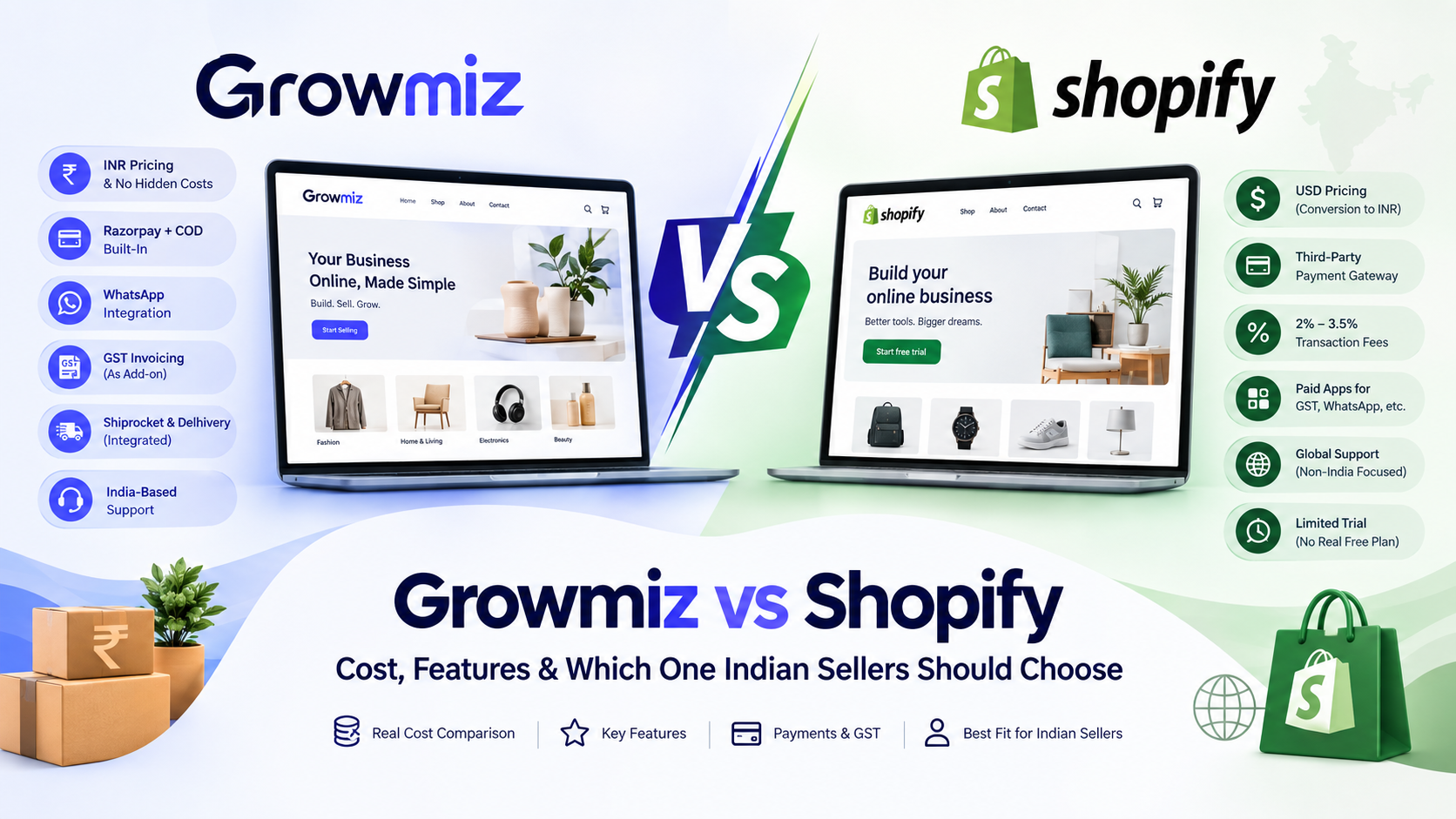
If you are an Indian manufacturer, distributor, D2C brand or retailer trying to sell online, chances are Shopify has already crossed your mind. It is, after all, the most talked-about ecommerce platform in the world. But talk to any Indian seller who has actually run a Shopify store for a year, and you will hear the sa
Growmiz vs Shopify: Cost, Features & Which One Indian Sellers Should Choose
If you are an Indian manufacturer, distributor, D2C brand or retailer trying to sell online, chances are Shopify has already crossed your mind. It is, after all, the most talked-about ecommerce platform in the world. But talk to any Indian seller who has actually run a Shopify store for a year, and you will hear the same complaint: the sticker price is never the real price.
Between subscription fees billed in dollars, transaction charges, GST, and a small army of paid apps needed to make the store "India-ready," the final bill often looks nothing like what the pricing page promised. This has opened the door for platforms built specifically for the Indian market — and Growmiz is one of the more complete answers to that gap.
In this post, we will break down how Growmiz and Shopify actually compare on cost and features, so you can make a decision based on numbers rather than marketing pages.
The Core Difference: Global Platform vs India-First Platform
Shopify was built for a global merchant base, and it shows. Its pricing is quoted in US dollars, its payment infrastructure defaults to gateways that work best outside India, and most India-specific needs — GST-compliant invoicing, COD support, WhatsApp order updates, local courier integrations — are not built in. You add them through third-party apps, and each app usually comes with its own monthly fee.
Shopify currently runs five pricing tiers in 2026: Starter, Basic, Grow, Advanced, and Plus, with the higher tiers aimed at larger operations. Once you convert these to rupees and add the extras Indian sellers typically need, the picture changes quickly.
Growmiz takes the opposite approach. It was built for Indian manufacturers, distributors, D2C brands and retailers from day one, with GST invoicing, Razorpay and COD payments, WhatsApp integration, and Indian courier partners like Shiprocket and Delhivery included in the core product rather than bolted on as add-ons.
Cost Comparison: What You Actually Pay
This is where the two platforms diverge the most.
Shopify's pricing reality
Shopify's Basic Plan is aimed at newcomers and starts with a promotional rate for the first three months before settling into its standard monthly price, while the mid-tier Shopify Plan adds performance reporting, more staff accounts, and gift card support. The Advanced Plan, meant for high-volume merchants, brings custom reporting and the lowest transaction fees among the standard tiers.
On top of the plan fee, Indian merchants run into a cost that rarely shows up in the headline numbers: since Shopify's own payment gateway is not available in India, every merchant has to route payments through a third-party gateway, which adds its own transaction charge on top of Shopify's per-plan fee, and 18% GST applies across all of it.
Then there are the apps. A working Shopify store for the Indian market typically needs separate apps (and separate monthly bills) for GST invoicing, WhatsApp notifications, COD verification, shipping integrations, and basic SEO extras — each one a recurring cost that compounds over a year.
Growmiz's pricing reality
Growmiz runs on a single yearly plan model rather than a monthly dollar subscription. The base plan is currently priced at ₹5,999 for the first year (regular price ₹9,999/year), and it includes 40 features out of the box — a drag-and-drop editor, up to 20 products, a full ecommerce storefront with cart and checkout, Razorpay and COD payments, order and customer management, GST invoicing as an add-on, WhatsApp order updates, and shipping integrations with Shiprocket and Delhivery.
Importantly, Growmiz charges 0% platform transaction fees, whereas most Shopify-style builders in India charge 2% to 3.5% per transaction on top of the subscription. For a seller doing consistent monthly sales, this alone can outweigh the difference in plan pricing.
There is also a genuinely usable Free plan (one website, up to five products, free SSL, and a contact/enquiry dashboard), which lets a seller test the platform before committing any money — something Shopify's dollar-denominated trial cannot really match for a small Indian seller working out cash flow.
Feature-by-Feature Comparison
| Feature | Shopify | Growmiz |
|---|---|---|
| Pricing currency | USD, converted to INR | INR, flat yearly plan |
| Payment gateway | Third-party only (no native India gateway) | Razorpay + COD built in |
| Transaction fees | 2% to 3.5% depending on plan | 0% platform fee |
| GST invoicing | Requires a paid app | Available as an add-on |
| WhatsApp integration | Requires a paid app | Built into the platform |
| Local courier integration | Via third-party apps | Shiprocket & Delhivery included |
| AI content generation | Paid app/add-on | Included (Groq-powered) |
| Local delivery / QuickStore model | Not a native model | Dedicated QuickStore site type for hyperlocal delivery |
| Appointment booking | Requires a paid app | Included |
| Customer support | Global support model | India-based support |
| Free plan | Limited trial only | Genuine free-forever plan |
Where Shopify Still Has an Edge
To be fair to Shopify, it is not the wrong choice for everyone. If you are building a brand that plans to sell internationally from the start, need access to Shopify's enormous app marketplace for highly specific integrations, or want a platform with the largest possible ecosystem of themes and developers, Shopify's scale is hard to match. Its app store alone offers thousands of extensions covering nearly every ecommerce use case imaginable, and its infrastructure is proven at very high order volumes.
The trade-off is that this scale and flexibility comes at the cost of simplicity and, for Indian sellers specifically, a lot of extra spending just to make the platform work the way an India-first tool would out of the box.
Where Growmiz Makes More Sense for Indian Sellers
For the large majority of Indian manufacturers, distributors, D2C brands, and retailers who are not selling primarily to international markets, Growmiz removes most of the friction Shopify introduces:
- No currency conversion headaches — pricing, invoicing, and payments all work natively in rupees.
- GST compliance without hunting for an app — invoicing is built into the platform's add-on system rather than requiring a third-party developer's app.
- WhatsApp is a first-class channel, not an afterthought, which matters given how much of Indian ecommerce communication still happens over WhatsApp.
- Local delivery businesses get a dedicated model — the QuickStore site type is built specifically for pincode-based, hyperlocal delivery, something Shopify has no direct equivalent for.
- Zero transaction fees mean your margins are not quietly eaten away with every sale.
- A real free plan lets you test the platform, get a product catalogue live, and start taking enquiries before spending a rupee.
Conclusion
If your business sells physical products or services primarily within India, needs GST-ready invoicing, relies on WhatsApp and COD as much as (or more than) online card payments, and wants to avoid stacking paid apps just to reach feature parity — Growmiz is built for exactly that situation, at a fraction of what an equivalent Shopify setup would cost once apps, transaction fees, and GST are added up.
If your priority is a global-scale platform with the widest possible app ecosystem and you are building for international markets from day one, Shopify remains a strong, proven option — just budget for the real cost, not the headline number.
For most Indian small and medium businesses, though, the calculation is straightforward: fewer add-on costs, built-in India-specific tools, and no per-transaction fees make Growmiz the more economical and more practical choice.